You are carrying more music in your pocket than any human being who lived before 2001. Roughly a hundred million songs, available in about two seconds each, for the price of a sandwich per month.
You own none of it.
Not one track. Cancel the card, lose signal in a parking garage, or watch a licensing deal quietly expire, and the whole library evaporates. This is such a normal arrangement now that describing it out loud sounds a little paranoid. It is still true.
There is a small and shrinking group of people who never went along with this. They keep files. Actual files, with names, in folders, on devices they can hold. Some of them use a laptop. Some of them fight their phone into cooperating, which in 2026 is genuinely annoying and getting worse. And some of them carry a dedicated player, a little slab whose entire job is to play audio files off local storage, made by companies you have never heard of for an audience that will not let this go.
I love that niche. I release music into it on purpose.
So here are my three songs, collected as TWO_ROOMS, as zip files you can download and keep forever. No account, no email, no gate. MP3 if you want small, FLAC if you want lossless with proper tags and artwork, or the actual WAV masters if you want the exact files that came off the mastering desk. They are at the bottom of this article, and they are yours.
Why the record has two rooms and three songs
The title is Jungian, and it is not a headcount.
Carl Jung's model of a person has a lit room and a dark one. The lit room is the part you show: the persona, the self you can narrate, the version of you that answers email. The dark room holds everything you have declined to look at, which does not mean it is evil, only that it is unlit. Jung's argument, the whole load-bearing idea, is that the dark room is not a basement you can seal. It is a room in the same house. The stuff in there keeps its own hours and lets itself out.
The record is not set in either room. It is set in the doorway between them.
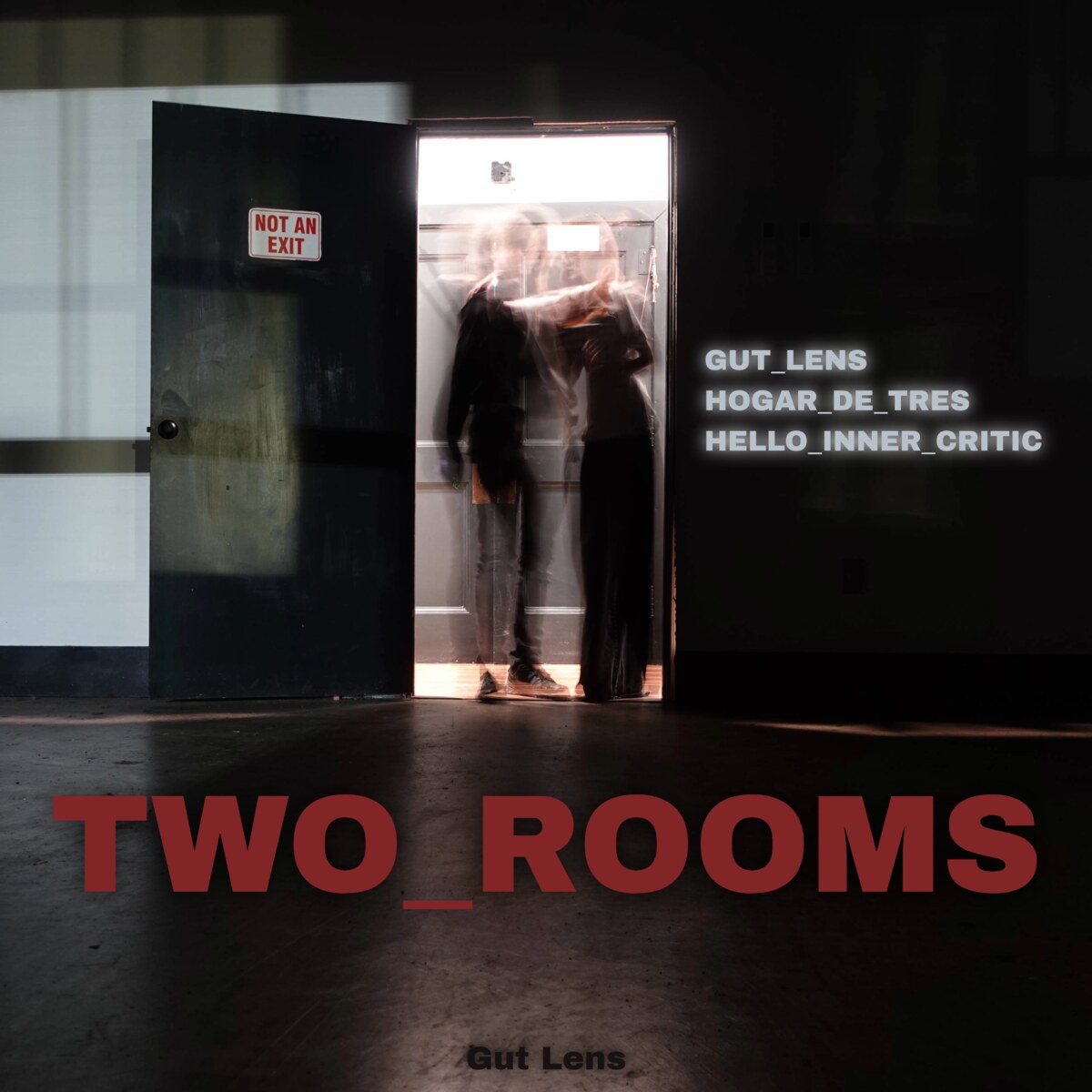
That is what the cover is, literally. A figure smeared across a threshold by a long exposure, because it is in both rooms at once and the camera cannot decide. Warm light behind, dark concrete in front. And on the open door, a red sign reading NOT AN EXIT, which was already screwed to that door when I found it, and which is the truest thing on the whole sleeve. There is no getting out of this. There is only getting through.
Three songs, three different kinds of traffic through that doorway.
GUT_LENS: the dark room talking over the lit one
The gut lens is a threat filter. When it goes primary, the body speaks first and the mind has to chase it with a flashlight, arriving late and out of breath to a conclusion the nervous system reached a half-second ago.
If the gut lens is primary my body's screaming duck and cover Slip and jab jab and slip my heart keeps breaking over and over
Duck and cover is not drama, it is choreography. It is the body rehearsing impact so it will not be surprised by it. Slip and jab is approach-avoidance in real time: reaching for closeness, flinching, reaching again. The heartbreak repeats because the connection is real and the stakes feel absolute.
The part I am most attached to is smaller. Claws like a tether, sickening purr. And I'm choking on the word we. A purr is comfort. When fear is in the room, comfort lands like an alarm, because continuity itself starts reading as a threat. And "we" is simultaneously the most wanted word in the language and the hardest one to breathe inside.
The song does not resolve that. It anchors it, in a Rumi passage sung straight through the middle:
I see healing in every pain I see compassion in every rage on the plains of the earth And in the nine levels under the dome of vast heavens I see only you in every stage
Which is what keeps the song from being an accusation. Nobody is on trial. It is nervous-system weather, reported honestly, with a vow underneath it.
HOGAR_DE_TRES: trying to build a home while both rooms are occupied
Three is a strange shape for people to be. Not unstable exactly, but never at rest. Any two points make a line; three make a plane, and a plane can tilt.
The song is sung in three languages, and each one is doing a specific job. The Spanish carries the tenderness of shared daily life, the small domestic facts of it: en cada rincón un suspiro compartido, in every corner a shared sigh. The Japanese opens the ceiling. Sora wa hiroku, hikari ga yureru, hateshinaku. The sky is wide, the light shimmers, without end. Three hearts, their light overlapping, without end.
And then Robert Frost walks in and tethers the whole thing to the ground:
The woods are lovely, dark and deep But I have promises to keep And miles to go before I sleep
That refrain is the hinge of the record. Beauty can be completely real and you still have obligations in the morning. The song is not a verdict on anyone and it is not a message to any one person. It is a record of endurance, and of the complicated peace available to you when you accept a shape you cannot control.
HELLO_INNER_CRITIC: the crossing itself
This one is the title track of the idea, which is funny, because it is the newest song and it is not called TWO_ROOMS.
It opens with what sounds like language breaking:
oo nah ebin wah nips mah
That is "i'm spent on the back nine," played backwards. It is there because when you are depleted enough, even your own meaning arrives corrupted. The mind is still running. The signal is inverted.
Then the sentence resolves forward and the song sits down inside the exhaustion. I do not play golf, but the back nine is a perfect image: the second half of the course, where momentum stops helping and you feel every step. Past fresh. Past fueled. Still walking. And underneath it the hard confession, i can't let go, which is not romantic. It is grip. It is the part of the nervous system that keeps clenching, because releasing feels like falling even when releasing would be mercy.
Then the song turns, and this is the whole record in one move:
now i must talk directly to you i feel you
The "you" is not a person. It is the inner critic. The voice that narrates danger and failure and collapse, and genuinely believes it is running security.
you think you're keeping me safe but you're just making it worse
Notice what that is not. It is not an exorcism. "I feel you" is contact. Jung's point about the dark room is that banishing what lives there does not work, and generally makes it louder and stranger. You go in and you introduce yourself. Hence the title, which is a greeting.
The last line is the one I am most honest about:
i didn't realize i had invited you back in
The critic rarely kicks the door down. It comes in through fatigue, through uncertainty, through wanting something badly. Then it is back in the house, rearranging the furniture, calling it help.
You can hear the crossing in the production. The first half is shredded, and the second half is a much softer voice. That is the difference between being inside the storm and speaking from the eye of it. Not peace. Just a clearer voice taking the wheel.
The part I did not do
All three songs were mixed and mastered by Tim Gennert, who as far as I am concerned is the best in the world at what he does.
From his site:
I think good audio is not about sound quality.
It is how well recording communicates what is essentially valuable in human expression and the spirit of music.
When this perspective is used to examine the tools and processes we use, in the end it translates to extraordinary audio.
I would like you to run an experiment, and this is the actual reason the lossless files exist.
Put one of these next to a current commercial hit record. Same playback, same volume. Do not listen for loudness or brightness. Listen for depth: how far back the far things sit, how much air is between the near thing and the far thing, whether the space behind the vocal is a real place or a flat wall. Most modern masters are a magnificent hedge, everything pushed forward, nothing behind anything else. These have front-to-back distance. Things stand in different places.
That is mostly Tim's fanaticism about craft. It is partly the signal path. He mixes through a 16-channel analog summing buss that I designed and built for him by hand years ago, back when I ran a boutique high-end analog audio company called Woven Audio. Summing in the analog domain does something to depth and separation that I can hear immediately and still cannot fully account for on paper.
Building that box was one of the better things I have done with my hands. Hearing it still working, years later, on my own songs, mixed by someone better at this than me, is a strange and excellent feeling.
Take the files
Each zip unpacks to a single TWO_ROOMS folder containing the three tracks, cover art as both cover.jpg and folder.jpg so every player finds it, and a LINER_NOTES.txt with full credits and all the lyrics.
- MP3, 320 kbps, 29 MB: tagged with artwork, plays on absolutely anything
- FLAC, lossless, 67 MB: bit-identical to the masters, properly tagged, the one I would take
- WAV, the masters, 118 MB: the exact files, untouched, no tags because WAV cannot carry them reliably
They are also on Spotify, Apple Music, and YouTube Music, and streaming them is a completely good way to listen. But streams are weather. Files are furniture.
Keep them, copy them to your devices, hand them to somebody. Just do not sell them or upload them to streaming services, and we are square.
The door in that photograph says NOT AN EXIT, and I keep thinking about how much better that is than any title I could have invented. You do not get out of the room you would rather not be in. You get a doorway, and some light coming through it, and three songs to play while you stand there deciding.
Timothy