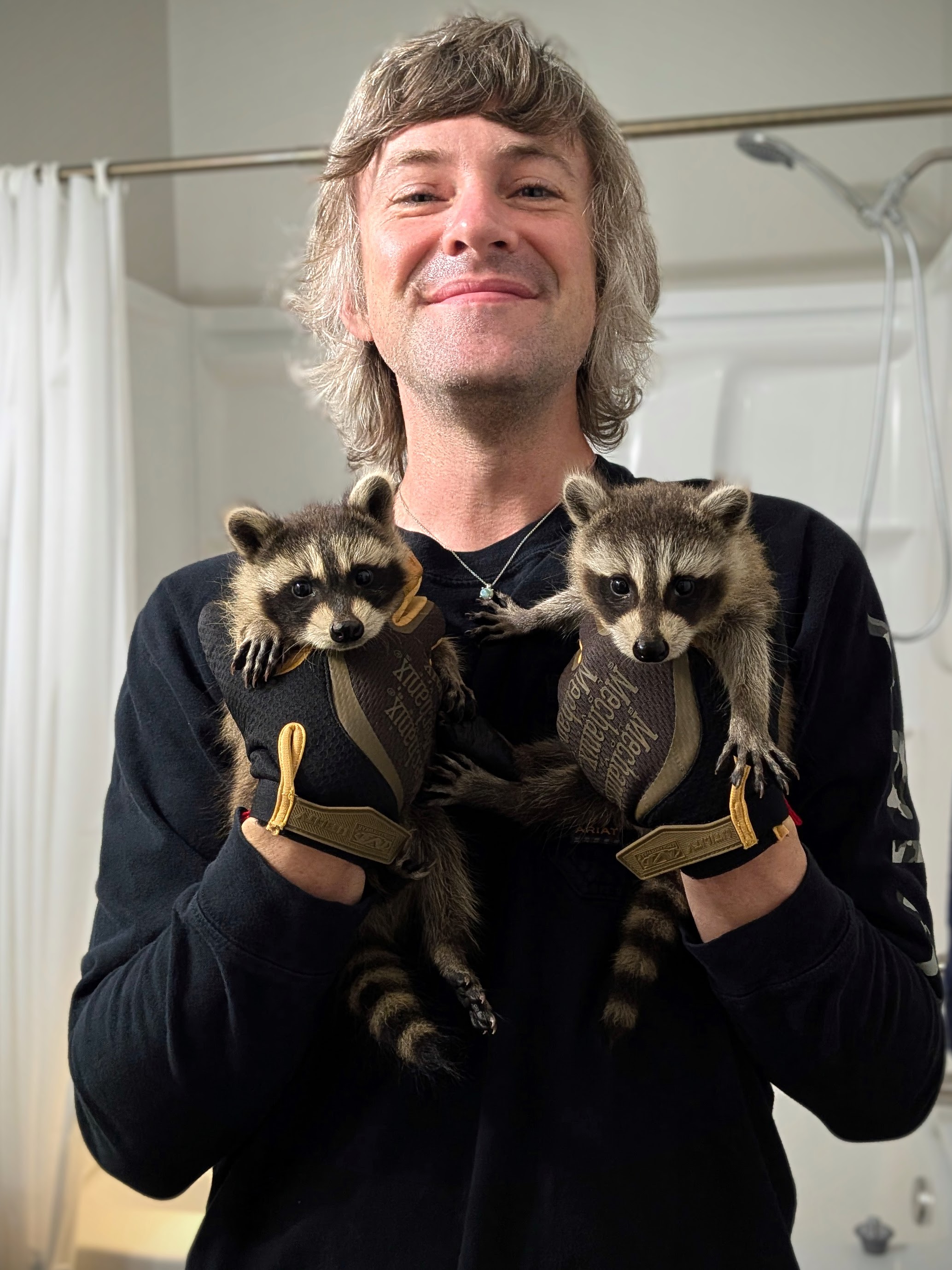
For a few nights there was a scratching in the wall behind my bed. I did the responsible-homeowner thing: caught the raccoon I eventually spotted and relocated it well away from the house. Problem solved. Except the scratching didn't stop.
Late the next night I found the real source out on the wrap-around deck. A tiny kit — I'd name him Charls — was balanced on the handrail, and his sister was peeking out of a gap in the porch ceiling, the one I'd name Doozy. I grabbed a plastic bin and a pair of gloves, scooped up Charls, then reached up and lifted Doozy down out of the rafters. Two orphans, maybe six or eight weeks old. Looking back, probably younger. And suddenly, entirely, mine to figure out.
Meeting Charls and Doozy
They were impossibly sweet. They climbed my arms and shoulders and burrowed into the crook of my neck, and when they got scared they screamed — a thin, insistent wail that only stopped when I gave them unflavored Pedialyte, drop by drop, from a dropper. So I named them, because you name things you've decided to keep alive: Charls and Doozy.
Within a day they'd claimed me as furniture. Here's what an ordinary afternoon looked like — one kit on each shoulder while I tried to get anything done:
The plan felt simple and responsible. In the morning I'd hand them to the local wildlife vet — the kind of place that takes in fallen fledglings and orphaned squirrels — and they'd take it from there.
The hang-up
I called the vet the next morning. They hung up before I got a full sentence out.
So I improvised. The gold-standard formula for raccoon kits is a specialized replacer called Fox Valley 40/25, but you can't walk in and buy it the same day. What you can get is Esbilac puppy milk replacer from the Tractor Supply down the road, so that's what I used — cut heavily with Pedialyte at first so I didn't shock their stomachs, then edged toward full formula over a day.
There's more to it than a bottle. You feed them belly-down, never on their backs, because a kit that inhales milk gets pneumonia and dies. After every single feeding you rub their bellies with a warm, damp washcloth, because kits this young physically cannot go to the bathroom without being stimulated to. You keep them warm against a hot water bottle wrapped in a towel, because a cold kit can't digest. Every three to four hours, around the clock. A week of six-a.m. feedings.
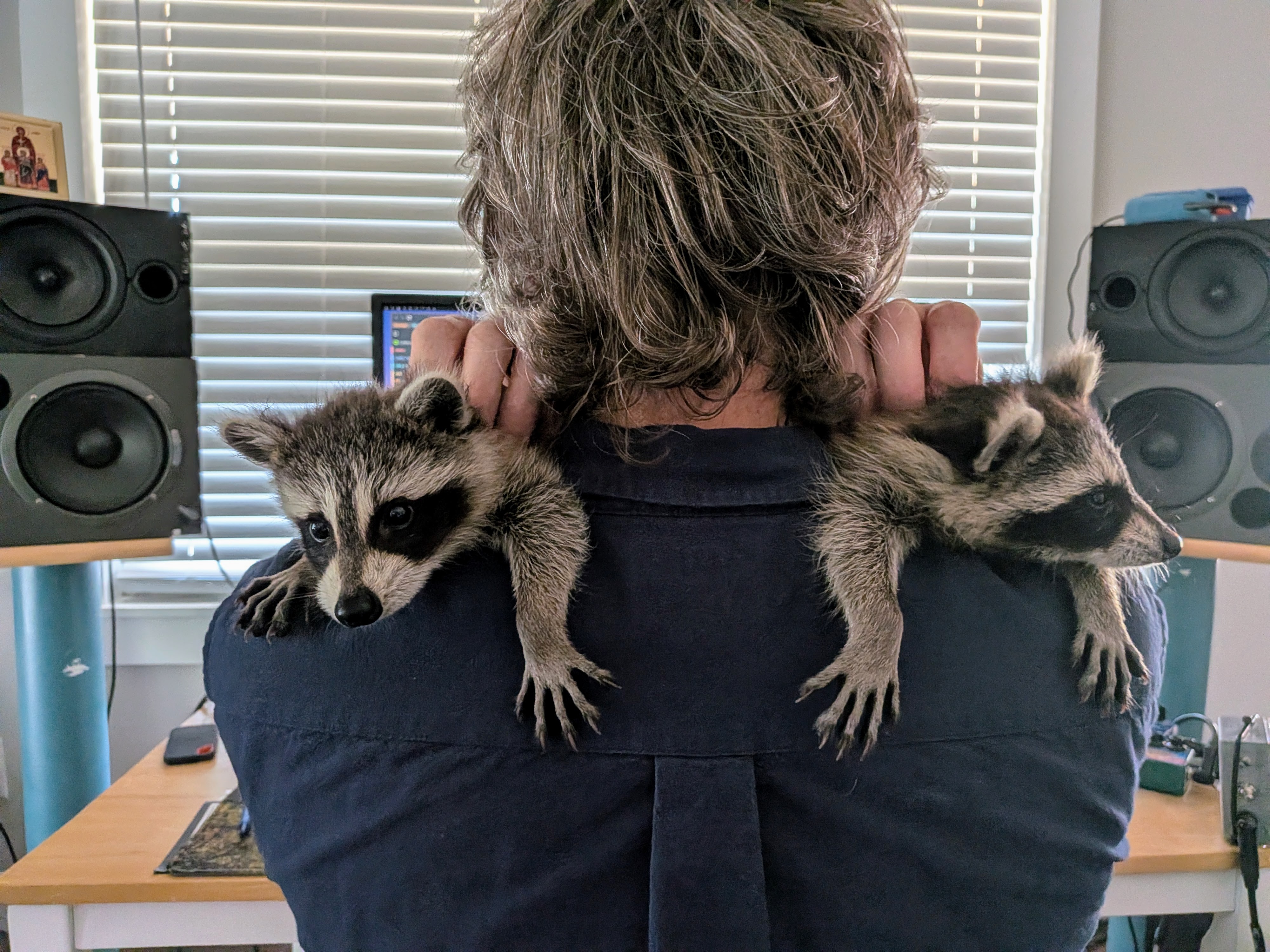
Somewhere in that week the dangerous thought crept in — the one everyone has. They were so easy to love. Could we just keep them?
The reality check
A week in, I called the vet again, and this time reached a person. That's when I learned the phrase that reorganized the whole situation: Rabies Vector Species.
Raccoons are RVS. Keeping one in Tennessee is illegal. There is no live test for rabies — the only way to test an animal is to euthanize it and examine its brain tissue. And because of that, any reported scratch or bite is legally an exposure, the kind that can trigger a state-mandated euthanasia order for the animal and a shot series for you.
I thought about the little claw-scratches on my forearms — the ones that go pink for a minute and never break the skin — the way anyone thinks about them after a sentence like that. The two sweet, sleeping animals in my bathroom had quietly become contraband.
"Let them die."
The official channels were a wall. The state wildlife agency, TWRA, didn't call back. A state-listed nature park — one of the places you're supposed to call — finally put a human on the phone, and when I asked what I should do, the answer was three words.
"Let them die."
I want you to sit with how that lands when you've spent a week keeping two orphans alive, when they're asleep in your bathtub curled against a warm water bottle. For an afternoon I genuinely believed my only real options were to break the law for five months — raise them in secret to a soft release in the fall, build a predator-proof enclosure, slowly wean them back to wild — or to do what the woman on the phone said.
The underground railroad
I refused that, and kept digging. What I found is that the compassion doesn't live in the official system. It lives in a quiet network of people who took the trouble to get licensed for the animals nobody else will touch.
A licensed rehabber named Geri Wynn didn't have room herself, but she had something better: a number. A woman named Marybeth, at a small rescue called Mountain Tails — texts only, because she's a volunteer running flat-out. I sent her photos and the whole story. She wrote back that she'd take them. The only catch was two hours of interstate: she's near Knoxville.
The six o'clock run
It was just Mason and me for the drive — the boys were with their mom that night. We packed the kits into a carrier lined with the towels they'd been sleeping on, tucked a freshly filled hot water bottle, wrapped in a towel, in beside them, and gave them one last bottle. Then down I-81, onto I-40, the light going gold and then going blue.
By twilight we were in the Knoxville area, handing two drowsy raccoons to exactly the right person. Here's the moment we met Marybeth and passed them over — the end of the whole ordeal:
Rogue caretakers for a week; a clean handoff at the end of it.
The part that stays with me
People love the statistic that a raccoon can live twenty years in captivity and only two or three in the wild. It's true, and it's the exact thought that tempts you to keep them. But those twenty-year raccoons live in professional zoos and nature centers, not living rooms. Raccoons aren't domesticated — that takes millennia — and around a year old their hormones arrive and the cuddly kit becomes a territorial adult that bites the hands that fed it and opens holes in your walls. Which is why the people who try to keep them almost always end up caging them for everyone's safety. Fifteen or twenty years in a cage isn't a kindness. A shorter, wilder life is the better one.
Here's what I can't shake. The laws that turned Charls and Doozy into contraband exist for a real reason — rabies is genuinely terrible, and public health matters. But the system built on top of that reason ends up punishing the exact instinct it should be able to rely on. An ordinary person who finds two helpless animals is left with three doors: break the law, drive a hundred miles, or let them die. I got lucky enough — and stubborn enough — to find the second door.
Charls and Doozy are safe now, growing up with other kits, eating the right things, learning to be the wild animals they were always going to be. That's the whole reward. It shouldn't have been that hard to get to.