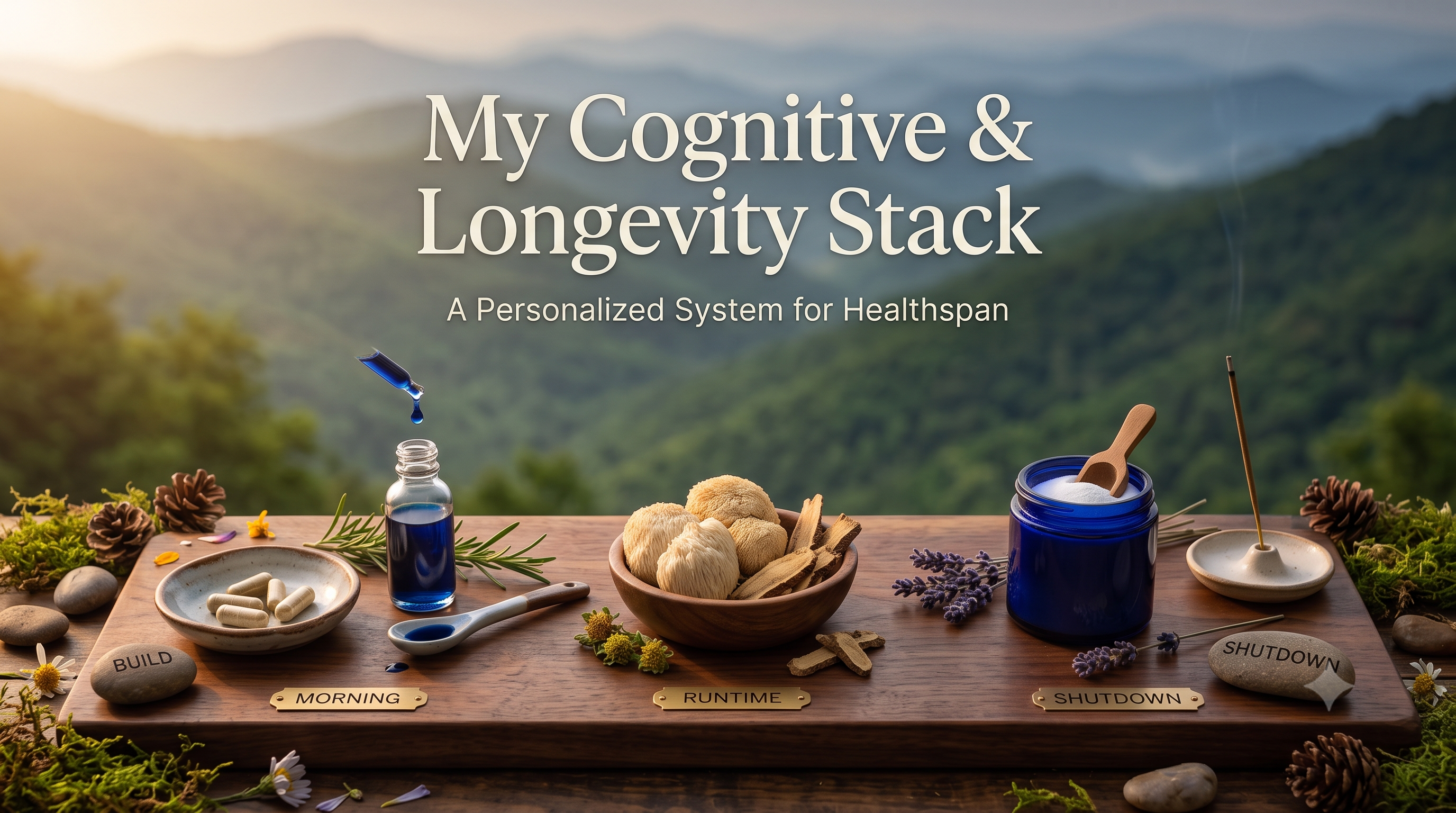
Yes, I'm aware. I'm in my health-bro phase. There's a pill box with three compartments, a bottle of methylene blue on the counter, and I will, if you let me, talk to you about my morning cortisol curve. I've made peace with it. Read on at your own risk.
This is a log, not a prescription. It's what I take, when I take it, and — the part I actually care about — why, in the order the day asks for it. I'm a software engineer, not a doctor. Some of what's below is prescription-grade (there's a compounded capsule and a bottle of methylene blue in here), arrived at with actual medical guidance for my own body. Copy none of it blindly. Read it the way you'd read someone else's dotfiles: interesting, opinionated, and absolutely not guaranteed to run on your machine.
There's a real reason underneath the theater, and I'll put it plainly because it's the truest thing in this article: my partner asked me, specifically, to try to outlive them. To max my healthspan so that when it matters, I'm still here. That's the whole optimization function. Everything below — the run, the drops, the timing — is in service of a promise I intend to keep.
The frame that makes the whole thing legible is one every developer already knows. A day has a build (the morning, when you bring the system up), a runtime (midday, when it does real work under load), and a shutdown (evening, when you bring it down cleanly so it comes back healthy tomorrow). Everything I do is timed to one of those three phases. And it all rides on top of a single curve I don't take in a pill at all: cortisol.
Phase 0: The Cold Start
Before any capsule, before coffee, before I've looked at a screen — I move for thirty minutes. First thing, on waking. When the trail isn't sheeted in ice, that's a roughly two-mile run through the hills where I live in Appalachia, and always, ice or not, it's sunlight straight into my eyes. That's the whole boot sequence: get up, get outside, get light, get the heart rate up.
I can tell you plainly that on the mornings I hit this, the entire day runs better — steadier focus, a calmer baseline, sleep that lands harder that night. For a long time I assumed the reason was vague and motivational. It isn't. It's cortisol, and cortisol has a terrible reputation it mostly doesn't deserve.
Cortisol is not the stress villain the wellness internet made it into. It's your body's wake-up-and-go signal — the hormone that pulls you out of sleep's basement and brings the lights up. It follows a daily curve on purpose: there's a sharp, healthy spike in the first hour after waking, called the cortisol awakening response, and then it's meant to taper down all day long until it bottoms out at night so melatonin can take the room. A good day is a steep morning peak and a clean downslope. A bad day is a flat, smeared-out curve — groggy in the morning, wired at midnight.
Morning light and a hard run don't manufacture some toxic stress spike. They sharpen and anchor the spike your circadian rhythm already wants. The light hits your eyes and tells the master clock "it's morning, start the timer" — which is also what schedules melatonin to arrive about sixteen hours later. The run drives the awakening cortisol response up crisp and early, exactly where it belongs, so it has the whole day to fall. You're not adding stress; you're giving the curve a clean leading edge.
Which is the entire reason I don't exercise in the evening. A hard workout at night spikes cortisol precisely when the curve is supposed to be scraping the floor — it fights the downslope, delays the melatonin handoff, and turns "tired" into "tired and wired." Morning movement and evening shutdown aren't two habits. They're the same curve, respected at both ends.
Phase 1: Early — The Morning Baseline
Timing: first thing in the morning, with breakfast or a source of healthy fats. Delivery: the capsules go down with a large glass of water carrying one to two vertical drops of methylene blue.
This is the build phase. Bring the core systems up, and — critically — bring them up in the right order, because several of these depend on each other.
7-in-1 compounded capsule — tadalafil (8.5 mg), finasteride (1.2 mg), minoxidil (3 mg), biotin (2.5 mg), vitamin B12 (1 mg), vitamin D3 (0.05 mg / 2000 IU), L-theanine (50 mg). This is the anchor of the morning schedule: systemic vascular health and the baseline daily maintenance for hair, folded into a single capsule so there's nothing to forget.
Vegan vitamin K2 + D3 — vitamin D3 (125 mcg / 5000 IU) and vitamin K2 as MK-7 (90 mcg). This is the safety switch, and it's a genuinely elegant piece of systems design. The heavy D3 dose aggressively pulls calcium into the bloodstream — good for immune function and mood — but calcium in the blood has to go somewhere. The K2, in its long-acting MK-7 form, activates the proteins that route that calcium straight into your bone matrix instead of letting it settle in your arteries. D3 opens the valve; K2 points the pipe. You do not want the first without the second.
Vegan omega-3 algae oil — algal oil (1000 mg, providing 300 mg DHA and 150 mg EPA) plus black seed oil (200 mg). Two jobs. It supplies the fatty-acid building blocks for the cell membranes in the brain and lowers systemic inflammation — and it's the fat delivery mechanism the fat-soluble vitamins ride in on. Take D3 and K2 dry and you absorb a fraction of them; take them alongside this and the morning stack actually lands.
Vitamin C (1000 mg) — a potent antioxidant, and here it's doing shift work. It helps modulate the morning cortisol output — not blunt it. Remember, I want that awakening spike from Phase 0; vitamin C keeps it from overshooting into a jittery fight-or-flight state and protects the nervous system while the curve does its job. It's the software governor on the hardware spike.
Methylene blue (1 to 2 drops / 2.5–5 mg), in the water glass — the one that sounds like a chemistry-set prank and isn't. At this titrated low dose it's an elite mitochondrial respiration enhancer: it works at the cellular level to optimize how the brain turns glucose into ATP — actual energy. As a bonus, at this dose it acts as a highly selective MAO-A inhibitor, gently slowing the breakdown of serotonin and dopamine to hold a stable mood and steady baseline focus. Low and vertical-drop-measured is the whole game here; this is not a "more is better" molecule.
Phase 2: Middle — The Midday Cognitive Peak
Timing: around noon to 1:00 PM, with lunch or a light snack. Objective: spin the processor up right when afternoon fatigue starts trying to derail complex engineering logic.
This is the runtime phase — peak load, real work.
Alpha BRAIN (standard dose) — temporarily elevates acetylcholine, the neurotransmitter behind processing speed, working memory, and flow state. There's a deliberate timing trick in dosing it at midday rather than morning: it pushes the acetylcholine peak back just far enough to feed vivid dream recall that night, without making early evening feel frantic.
Organic lion's mane mushroom (2 g) — works with Alpha BRAIN but on a completely different timescale. Where the nootropic is an acute boost, lion's mane stimulates NGF (nerve growth factor), supporting actual neurogenesis — the growth and repair of brain cells. One is today's performance; the other is next year's hardware.
B-complex (1 capsule) — vitamin C (60 mg), thiamin (25 mg), riboflavin (20 mg), niacin (25 mg), B6 (5 mg), folate (680 mcg DFE), B12 (100 mcg), biotin (1000 mcg), pantothenic acid (5.5 mg). Placed at midday on purpose: these are the water-soluble enzymatic cofactors the brain needs to convert lunch into usable cognitive fuel, and they're what physically lets the body synthesize the dopamine and acetylcholine the nootropics are trying to unlock. Cofactors before the reaction, not after.
Rhodiola rosea root extract (250 mg) — an adaptogen, and the load-bearing member of the afternoon. It regulates the stress response and shields against the slow grind of a heavy cognitive day, holding attention through sustained load without borrowing energy from the evening. No crash to pay back at dinner.
Phase 3: Late — The Evening Code Reset
Timing: 30 to 60 minutes before sleep. Objective: shut down the analytical logic loops, protect sleep architecture, and open the door to dream integration.
This is the shutdown phase — and a clean shutdown is what makes tomorrow's cold start possible.
Magnesium glycinate (240 mg) — the metabolic anchor of the entire routine, and the piece that closes the loop I opened at breakfast. It's highly bioavailable and deeply calming to the central nervous system, and it's a hard requirement for the body to actually process and activate the vitamin D3 from the morning. It relaxes muscle tissue and eases the brain out of its high-beta coding state. The morning's D3 and the night's magnesium are two ends of one dependency — take the first without eventually taking the second and you've left a transaction half-committed.
L-theanine (200 mg, standalone) — crosses the blood-brain barrier to promote alpha waves, the signature of relaxed alertness. Layered over the lingering afternoon B6 and Alpha BRAIN, this bedtime dose stabilizes the REM cycles and — the part I find genuinely remarkable — softens the emotional brutality of dreams. The subconscious landscape stays vivid and meaningful instead of turning stressful. (If you want to know what those landscapes actually look like, that's a different article.)
The Stack Is a System
None of these pieces stands alone, and that's the whole point. The morning D3 is inert without the evening magnesium. The fat-soluble vitamins don't land without the omega-3 riding shotgun. The midday acetylcholine peak is timed to arrive as dreams that night. The vitamin C governs a cortisol spike I deliberately provoked with a run at dawn. And every capsule in every phase is just riding a curve that light and movement set before I'd swallowed anything at all.
That's the part worth taking, if you take nothing else: the timing is the intervention. A supplement in the wrong phase is noise; the same supplement in the right phase is signal. Build in the morning, run under load at midday, shut down cleanly at night — and let the cortisol curve, not the pill box, be the thing you actually optimize.
Log, not prescription. Talk to someone with a medical degree before you touch any of this. But do go outside in the morning and get the light in your eyes — that one's free, and it's the load-bearing wall for everything else.
And if you've got someone who asked you to stick around: optimize for them. It's the best-specified requirement I've ever been handed.