You changed nothing. You tested it yesterday. You watched it pass. And now, on deployment day, everything is on fire.
If you've spent any time building software, you've probably been dragged into a special kind of chaos that the industry has lovingly named dependency hell. It's the place where your code is fine, everyone else's code is fine, but the combination of all of it together is decidedly not fine.
Let's talk about what it is, why it keeps happening, and what — if anything — you can do about it.
🧱 The Analogy
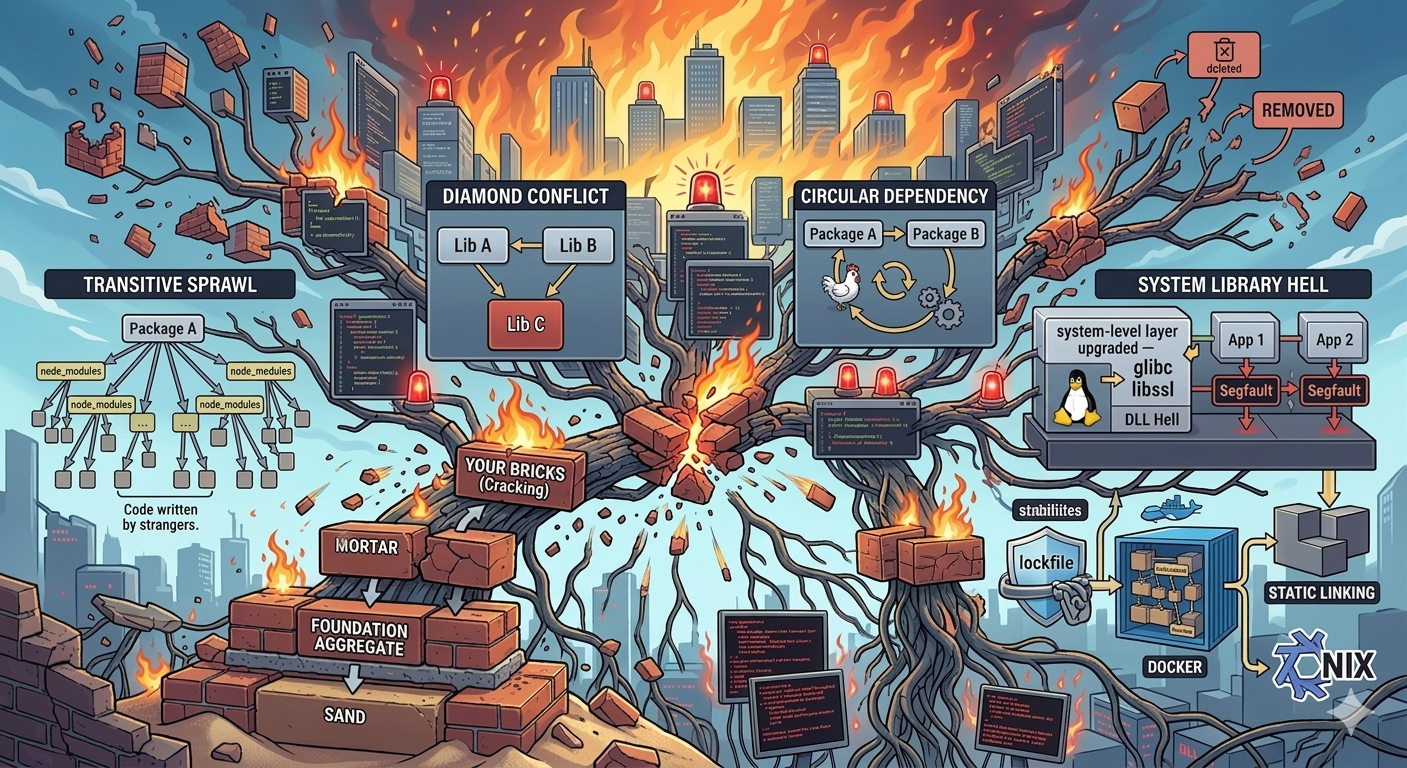
Imagine you're building a house. You need bricks, and each brick requires a specific mortar. Fine — you pick the right mortar. But the mortar requires a specific sand, and the sand is only compatible with a certain type of foundation aggregate. The foundation aggregate was updated last week and now requires a thinner mortar. But your bricks crack with thin mortar.
Nobody changed your blueprint. Nobody touched your bricks. But the house won't stand because three levels deep in your supply chain, someone "improved" their sand.
That's dependency hell. Your software depends on other software, which depends on other software, and somewhere in that chain, something shifted in a way that breaks the thing you're building — even though you didn't change a line of code.
🔥 The Taxonomy of Suffering
Not all dependency hell is the same. It comes in distinct flavors, each with its own special brand of misery.
The Diamond Dependency Problem
This is the classic. Your project depends on Library A and Library B. Both A and B depend on Library C — but they each require a different version of C. You can't install both versions simultaneously, so you're stuck. Your dependency graph forms a diamond shape, and at the bottom of that diamond is a conflict with no clean resolution.
Your Project needs Lib A and Lib B. Lib A needs Lib C version 1. Lib B needs Lib C version 2. You can only install one version of Lib C. Deadlock.
In some ecosystems, this is an unsolvable puzzle. In others, the tooling can deduplicate or isolate — but it's always a source of pain.
Transitive Dependency Sprawl
You install one package. That package pulls in 12 dependencies. Those 12 pull in 80 more. Before you know it, your node_modules directory weighs more than the application itself, and you're relying on code written by hundreds of strangers, any one of whom might push a breaking change, abandon their project, or delete their package entirely.
The real problem isn't the count — it's that you didn't choose any of those transitive dependencies. You don't know what they do. You don't know who maintains them. But your software can't run without them.
Circular Dependencies
Package A depends on B. Package B depends on A. Now nothing can be built first because everything needs the other thing to already exist. It's a chicken-and-egg problem that confuses build systems, package managers, and humans alike.
Circular dependencies are usually a design smell — they signal that two packages should either be merged or restructured — but they crop up in large codebases with organic growth.
System-Level Shared Library Hell
This is where things get truly nasty, especially on Linux.
When you install a program on a Linux system, it typically links against shared libraries — .so files that live in /usr/lib or similar paths. Multiple programs share the same library to save memory and disk space. Beautiful in theory. In practice, it means that upgrading one library can break every program that depends on it.
On Windows, this was historically called DLL Hell — the same fundamental problem with .dll files. On Linux, it manifests when a system update pulls in a new version of libssl, glibc, or some other foundational library, and suddenly half your installed software segfaults or refuses to start.
Package managers like apt and pacman try to manage this with dependency metadata, but they can only protect you from conflicts they know about. If you've installed anything from source, compiled against a specific library version, or mixed repositories — you're on your own.
The ABI (Application Binary Interface) is the invisible contract here. Source code might be "compatible," but if the compiled binary layout changes — struct sizes, function signatures at the machine level — everything breaks silently and catastrophically.
The Vendoring Dilemma
One natural response to shared dependency chaos is vendoring — bundling your own copy of every dependency directly into your project. This gives you total control. Nothing changes unless you change it.
The tradeoff? You're now responsible for updating everything yourself. Security patches don't flow downstream automatically. Your project bloats. And if everyone vendors everything, you end up with twelve different versions of OpenSSL running on the same machine, each with its own set of known vulnerabilities.
Vendoring trades one kind of hell for another. It's a valid choice, but it's not a free lunch.
💀 War Stories
Theory is nice. Let's talk about the times dependency hell actually set things on fire.
"It Worked Yesterday" — A Laravel Deployment Nightmare
I've lived through many of these wars, including this one. We had an application deployment that was tested and verified the day before launch. Everything passed. Every check was green. Ship it tomorrow.
Tomorrow came. The deployment broke.
What happened? Overnight, a transitive dependency in the Composer ecosystem had updated. Laravel's dependency constraints were strict enough to notice the change but not strict enough to prevent it from being pulled in. The package that resolved perfectly at 4 PM was unresolvable by 8 AM because something three levels deep had pushed a new minor version that conflicted with another constraint.
Nothing in our code changed. Nothing in Laravel's code changed. But the dependency graph that Composer had to solve was now different, and the solver couldn't find a valid resolution. Deployment day became debugging day.
This is the insidious nature of dependency hell — it can be time-dependent. The same composer install can produce different results on different days if you aren't locking your dependencies aggressively. And even when you do lock them, the moment you need to update anything, you're re-entering the negotiation.
left-pad and the Disappearing Package (npm, 2016)
In March 2016, a developer named Azer Koçulu unpublished a package called left-pad from npm. It was 11 lines of code. It padded strings with spaces on the left side. Trivial functionality.
The problem was that thousands of packages depended on it, including heavy-hitters in the React ecosystem. When it vanished, builds broke worldwide. CI pipelines failed. Production deployments stalled. Thousands of developers scrambled to figure out why their code — which they hadn't touched — suddenly wouldn't build.
left-pad exposed a deeper truth: when an ecosystem incentivizes tiny, single-purpose packages, the web of transitive dependencies becomes so vast that removing any single thread can unravel the whole thing. Your project didn't depend on left-pad. But your project depended on something that depended on something that depended on left-pad. And that was enough.
Python's pip and the Resolver That Couldn't
For years, pip didn't have a proper dependency resolver. It installed packages in order, and if two packages needed conflicting versions of a shared dependency, pip would simply install whichever one it encountered last — silently overwriting the other. Your install would "succeed," but your application would crash at runtime because it had the wrong version of something.
In 2020, pip finally shipped a real resolver. The good news: it catches conflicts. The bad news: it catches conflicts. Upgrades that previously "worked" (by silently being broken) now fail loudly with resolution errors. The Python ecosystem is still working through the aftershocks.
Linux Shared Libraries: The glibc Trap
On Linux, glibc — the GNU C Library — is the foundation that almost everything is built on. It provides the basic system calls, memory allocation, string handling, and threading that virtually every compiled program relies on.
Upgrading glibc can break programs compiled against an older version. Downgrading it can break your entire system. It's the one dependency where "just update it" and "just don't update it" are both dangerous advice.
Rolling-release distributions like Arch (and its derivatives, including Artix and Aegix) feel this more acutely than point-release distros like Debian. When your entire system updates continuously, the window for ABI-breaking changes is always open. You gain cutting-edge software at the cost of living permanently on the frontier of compatibility.
🤔 Why This Keeps Happening
Dependency hell isn't a bug in any particular tool. It's an emergent property of how software is built.
Semantic Versioning Is a Social Contract, Not a Technical Guarantee
Semver says: bump the major version for breaking changes, the minor version for features, the patch version for fixes. In practice, people get it wrong constantly. A "patch" release introduces a subtle behavior change. A "minor" release deprecates something your code relies on. Semver only works if every maintainer in your entire dependency tree follows it perfectly, and they don't.
Ecosystems Incentivize Small Packages
npm's culture of micro-packages means your dependency tree is wide and shallow — lots of packages, each doing one tiny thing. Python's culture is more "batteries included," leading to fewer but larger dependencies. Neither approach is immune. Wide trees have more points of failure; deep trees have more severe failures when they break.
Nobody Owns the Whole Stack
Your application sits on top of frameworks, which sit on top of libraries, which sit on top of system packages, which sit on top of a kernel. Each layer is maintained by different people with different priorities, release schedules, and opinions about backward compatibility. There's no central authority ensuring that the whole stack works together at any given point in time.
Time Is a Dimension of Your Dependency Graph
The same dependency resolution can produce different results on different days. Packages get published, yanked, deprecated. Registries have outages. Mirrors fall behind. Your build on Monday and your build on Friday might resolve to different dependency trees, even with the same input.
🛠️ Mitigation Strategies
You can't eliminate dependency hell, but you can build bunkers.
Lock Your Dependencies
Every modern package manager has a lockfile: package-lock.json, Cargo.lock, poetry.lock, composer.lock. Commit them. A lockfile records the exact versions that were resolved at a specific point in time. It turns your build from "whatever resolves today" into "exactly what resolved when we last explicitly updated."
If I had to give one piece of advice from this entire article, it would be this: use lockfiles and treat them as first-class artifacts.
Pin Transitives When It Matters
Sometimes the lockfile isn't enough. If you're deploying to production, consider pinning your transitive dependencies explicitly. Tools like pip-compile (Python), npm shrinkwrap (Node), and cargo lock (Rust) give you varying degrees of control over the full dependency tree.
Reproducible Builds and Nix
The most rigorous approach to dependency management is Nix. Nix treats every package — including its exact dependencies, build flags, and compiler version — as a unique, content-addressed entity. Two builds with the same inputs will always produce the same outputs. There is no shared mutable state.
Nix is powerful and philosophically sound. It's also a steep learning curve and a different way of thinking about your system. But if reproducibility is critical to you, nothing else comes close.
Containers: The Blunt Instrument
Docker and its kin solve dependency hell by side-stepping it entirely. Bundle everything — your app, your dependencies, your runtime, your system libraries — into a container image. Ship the whole thing. It works because it literally ships the machine.
The tradeoff is that you're vendoring at the OS level. Every container image carries its own copies of system libraries, and keeping those updated for security is now your problem. You've traded system-level dependency conflicts for image-level maintenance burden.
It works. It's pragmatic. It's not elegant.
Static Linking
Instead of relying on shared libraries at runtime, you can statically link everything at compile time. The resulting binary contains all its dependencies and runs anywhere (on the same OS/architecture) without caring what's installed on the system.
Go does this by default, and it's one of the reasons Go binaries are praised for their deployment simplicity. Rust makes it straightforward with musl targets. C and C++ can do it, but it's more manual and sometimes legally complex (LGPL licensing requires dynamic linking in certain cases).
The cost: larger binaries, no shared security updates across programs, and potential license headaches. But for deployment reliability, it's hard to beat.
🪢 The Fundamental Tension
At its core, dependency hell exists because of an unresolvable tension in software engineering: code reuse and independence are at odds with each other.
Every dependency you take on is a bet that someone else's code will continue to work the way you need it to, for as long as you need it to, without requiring changes on your end. Sometimes that bet pays off for years. Sometimes it blows up overnight.
The industry keeps building better tools — smarter resolvers, content-addressed stores, hermetic builds — and they genuinely help. But the fundamental problem won't go away because it's not a tooling problem. It's a coordination problem among millions of independent developers who don't know each other, don't share priorities, and can't predict the future.
The best you can do is understand the landscape, pick your tradeoffs deliberately, and always — always — check that lockfile.